📑 Table of Contents
Drop stitch portable swimming pools cost less upfront, go up in hours, and move with your business. Fiberglass pools are fixed structures built to last 20+ years on one site. Neither is better — they serve two very different business models. Pick the one that fits yours.
- ⚡ Setup time: Drop stitch pools are ready in 1–3 hours. Fiberglass takes 2–4 weeks of civil work.
- 💰 Upfront cost: Drop stitch cuts out excavation, crane hire, and concrete — saving tens of thousands on install alone.
- 🔄 Mobility: Drop stitch pools move. Fiberglass pools don't.
- 📈 Payback speed: Drop stitch typically pays back in 1–2 seasons. Fiberglass takes 3–8 years.
- 🏗️ Lifespan: Fiberglass lasts 15–25+ years in a fixed location. Commercial-grade drop stitch runs 3–8 years under regular use.
- 🌍 Best fit: Drop stitch suits rental fleets, resorts, and multi-site projects. Fiberglass suits luxury villas and permanent hotel builds.
1. What Is a Drop Stitch Portable Swimming Pool? 🏊
A drop stitch inflatable pool is a rigid-wall swimming pool you can inflate, fill, and use — all in the same afternoon. No digging. No concrete. No crane.
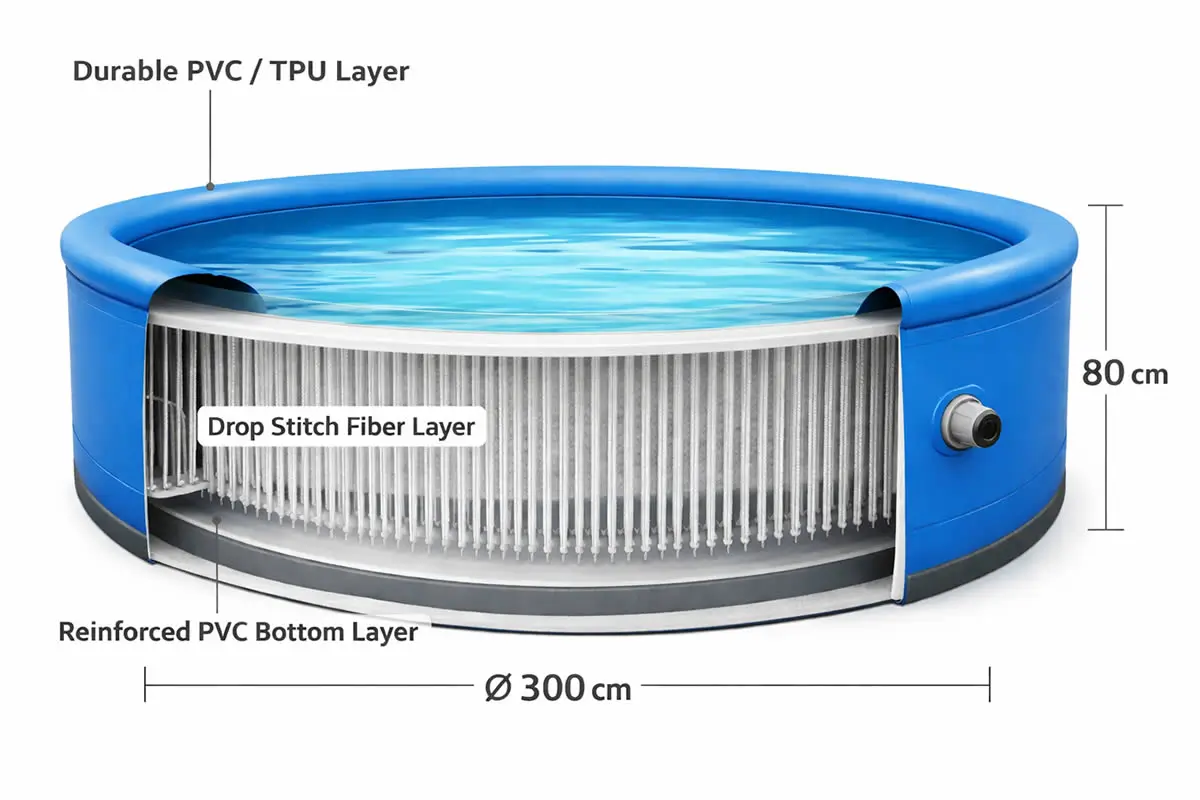
The secret is in the fabric. The pool wall is made from two layers of coated PVC. Thousands of vertical polyester threads stitch the two layers together — that's the "drop stitch." When you pump air in, those threads pull tight and hold the walls flat. At 0.15–0.20 MPa of operating pressure, the walls are stiff enough to hold back a full column of water. It works on the same principle as an inflated SUP paddleboard — just scaled up and rated for pool use.
1.1 How the Structure Actually Holds
Fabric weight runs from 600D to 1000D double-coated PVC tarpaulin. Drop stitch yarn density sits at 18,000–26,000 fibers/m² — the higher the density, the flatter and stiffer the wall at depth. Want the full technical breakdown? Our drop stitch technology explainer covers material grades, pressure ratings, and wall geometry in detail.
1.2 Where B2B Buyers Actually Use These
- 🏝️ Resort & hotel seasonal pools — set up on a lawn, rooftop, or beachfront without touching the ground permanently
- 🎪 Events and exhibitions — assembled the morning of, dismantled the same evening
- 🔑 Rental fleet operators — standardized units that move between client sites on a schedule
- 🏠 Residential rapid-install pools — no building permit needed in most jurisdictions
- 💆 Cold plunge & wellness centers — compact-format pools for recovery and hydrotherapy use
2. What Is a Fiberglass Pool? 🏗️
A fiberglass pool is a factory-molded shell. It ships to site on a flatbed truck, drops into an excavated pit by crane, and stays there for the life of the property. That's it — that's the model.
2.1 How It's Made and Installed
The shell is built up from layers of woven glass fiber fabric soaked in polyester or vinyl ester resin. Once cured, the shell wall runs 6–10 mm thick across the basin and 12–18 mm thick at structural ribs. The interior gets a gel coat for UV and water resistance.
On site, the process involves excavation, a compacted sand or concrete base, crane placement, plumbing connections, backfill, and coping work. ASTM International sets the baseline — standards like ASTM C581 and ASTM D2563 govern laminate quality and structural performance. Compliance with these is expected on any serious commercial or residential project.
2.2 Where Fiberglass Pools Make Sense
- 🏡 Luxury villas and high-end residential builds — where the pool is a permanent property asset
- 🏨 Permanent hotel and resort facilities — where structural longevity justifies the capital spend
- 🏢 Real estate development amenities — fixed infrastructure tied to the property value
3. Installation: Hours vs Weeks ⏱️
This is where the gap becomes very real. For project buyers, time on-site is money — in labor, in delayed revenue, and in risk.
3.1 Drop Stitch Pool: Inflate, Fill, Open
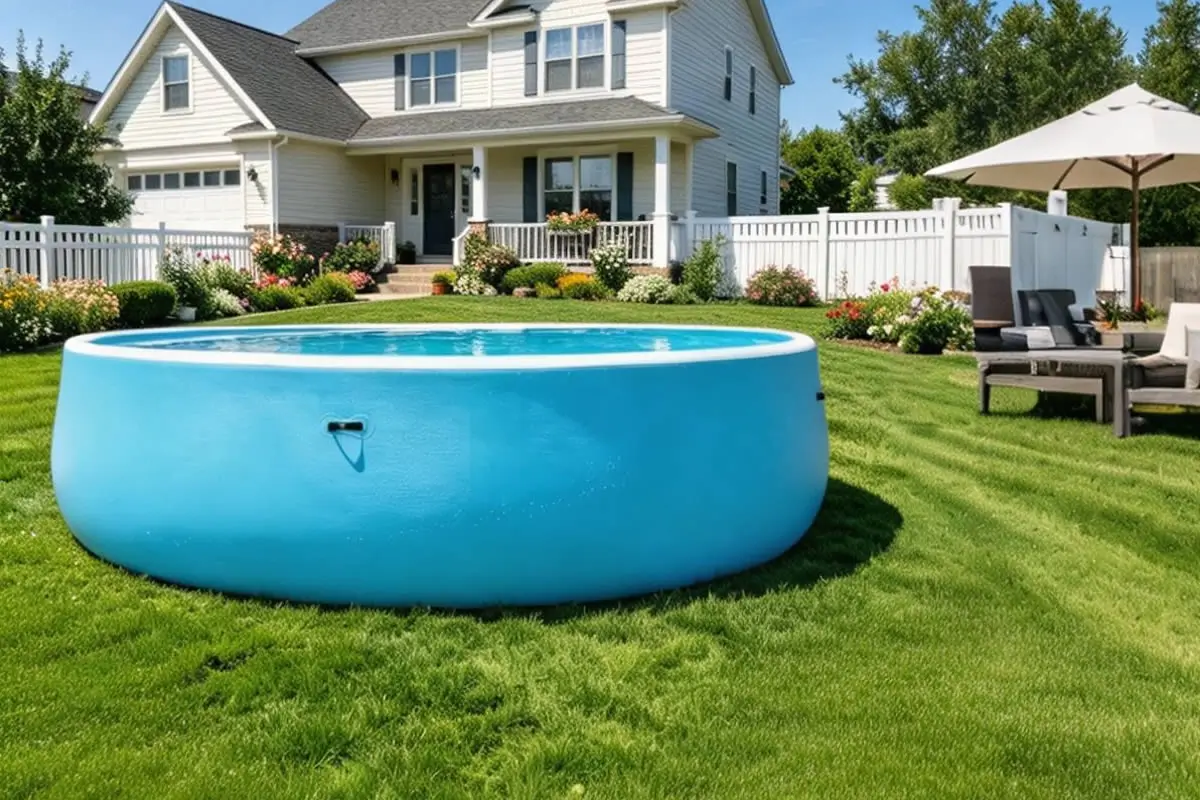
You need a flat surface, a power outlet, and a water hookup. That's the full site requirement. Here's how the setup runs:
- Step 1 — Unpack and position: Lay the deflated shell flat on your chosen surface. Takes 15–25 minutes.
- Step 2 — Inflate: Plug in the electric pump. A Ø5m diameter unit reaches operating pressure in 15–25 minutes.
- Step 3 — Fill with water: A Ø5m × 1.0m pool holds roughly 17–20 m³. At standard hose flow rates, that's 60–90 minutes.
- Step 4 — Connect the filter: Hook up the external pump and chemical kit. The pool is open.
Total time from unboxing to swimming: 1.5–3 hours. No civil contractor. No building permit in most markets. For the engineering behind what makes this possible, see our guide on DWF fabric thickness and pressure ratings.
3.2 Fiberglass Pool: The Full Construction Run
Fiberglass installation is a multi-trade project. Here's the typical sequence:
- Site survey and permits: 1–2 weeks pre-construction
- Excavation to 1.5–2.5 m depth
- Sand or concrete base layer
- Crane delivery and shell placement
- Plumbing, heating lines, and drainage
- Backfill, compaction, and coping work
- Water fill, chemical balance, and commissioning
Total elapsed time: 2–4 weeks under clean conditions. Add weather delays, permit backlogs, or trade scheduling gaps, and that stretches easily.
3.3 Side-by-Side: Labor, Permits, and Risk
| Factor | Drop Stitch Portable Pool | Fiberglass Pool |
|---|---|---|
| Setup time | 1–3 hours | 2–4 weeks |
| Crew needed | 1–2 people, no specialist | Excavation, crane, plumbing, electrical, civil |
| Permits | Not required in most markets | Building permit; often structural sign-off |
| Weather risk | Minimal | High — groundwork stalls in rain or frost |
| Can you move it later? | Yes — relocate in hours | No — fixed once installed |
A client in Southeast Asia came to us asking for a single 6m inflatable pool quote. Two weeks into the conversation, the real brief surfaced: they didn't want one pool. They wanted a distributed water experience across their property — something guests could find in multiple spots, not just one corner.
We brought in five Ø5m × 1.0m drop stitch round pools, split across two phases. The first three went onto the hotel's central lawn. Each unit took about 2 hours from unboxing to full water level — the inflation phase alone came in under 18 minutes per unit. The next two went to the beachfront for a children's activity zone and private event area.
Ninety days later, the numbers the operations director shared were clear:
- Family guest dwell time up roughly 30%
- Water experience zone spend conversion up roughly 27%
- Each pool node pulling independent daily activity revenue
- Previously idle lawn fully converted to a paid experience area
That's the shift we're seeing in this market. Drop stitch pools aren't just equipment anymore — they're how operators build flexible income into a property without locking capital into concrete.
4. Cost Breakdown: CAPEX & Installation 💰
The purchase price is only part of the story. Total project cost — what actually leaves your bank account before the first guest swims — looks very different for these two pool types.
4.1 Drop Stitch Pool: What You Actually Spend
- Product cost: Factory-direct pricing — significantly lower than an equivalent fiberglass shell
- Civil works: Zero. No excavation, no concrete, no crane hire.
- Ancillary equipment: External filter pump, chemical dosing kit, optional water heater — all standard off-the-shelf gear
- Permits: Not required for above-ground temporary structures in most jurisdictions (verify local rules)
- Exit value: You can relocate, resell, or redeploy the asset — your capital doesn't disappear into the ground
4.2 Fiberglass Pool: The Full Project Spend
- Shell cost: A standard 8m × 4m residential shell runs USD 15,000–40,000 depending on spec and market
- Excavation and groundworks: USD 3,000–12,000
- Crane delivery and placement: USD 1,500–4,000
- Plumbing, electrical, and filtration: USD 5,000–15,000
- Coping, surround, and landscaping: USD 5,000–25,000+
- Total installed: USD 30,000–100,000+ for a standard residential-scale project
4.3 The Numbers Side by Side
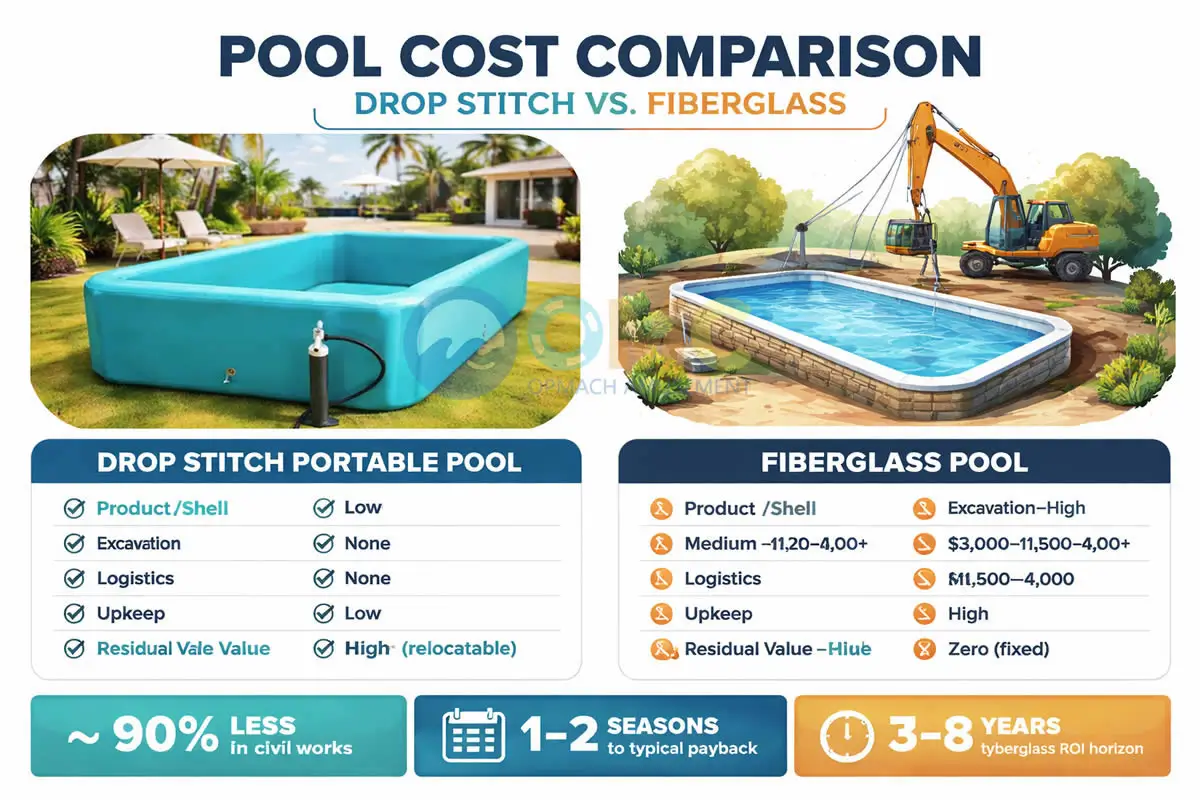
The global portable pool segment has grown steadily — and cost accessibility is a big reason why. Data from Mordor Intelligence points to strong demand growth in the hospitality and rental verticals, driven by exactly these economics: faster deployment, lower entry cost, and modular scalability.
| Cost Category | Drop Stitch Portable Pool | Fiberglass Pool |
|---|---|---|
| Product / shell | Low–Medium | Medium–High |
| Excavation | None | USD 3,000–12,000+ |
| Crane and logistics | None | USD 1,500–4,000 |
| Plumbing and electrical | Minimal (external pump kit only) | USD 5,000–15,000 |
| Annual upkeep | Low — no buried pipe infrastructure | Medium–High — pipe, chemical, and structural |
| Residual value | High — fully relocatable asset | Zero — cannot be moved |
5. Durability, Maintenance & Lifespan 🔧
Both pool types are built to last — just on different timelines and in different operating contexts. Knowing the material specs keeps you from making expensive assumptions.
5.1 Drop Stitch Pool: Materials and Service Life
Commercial-grade drop stitch pools run on 600D–1000D double-coated PVC tarpaulin. The seams are joined by high-frequency (HF) welding — a process that fuses the PVC layers at a molecular level. Seam tensile strength on a properly welded unit clears 3,500 N/5cm, which beats the base fabric itself. For detail on how weld parameters affect long-term seam integrity, see our article on high-frequency welding in drop stitch pool manufacturing.
On the compliance side, export-market products are tested against REACH Regulation (EC) 1907/2006 for PVC plasticizer safety. Third-party labs like SGS run the checks — phthalate content, tensile strength, tear resistance, UV weathering. Under normal commercial use — seasonal deployment, proper deflation, dry storage off-season — expect 3–8 years of service life. Heavier fabric weight (see our DWF fabric thickness guide) pushes that number toward the upper end.
5.2 Fiberglass Pool: Long-Term Structural Outlook
A fiberglass shell built to ASTM D2563 laminate standards, properly gel-coated, holds up for 15–25+ years in a residential setting. The main long-term risk is osmotic blistering — water works through the gel coat and causes subsurface delamination over time. Refinishing costs run USD 2,500–8,000+ depending on pool size and how far it's progressed.
5.3 Maintenance — The Day-to-Day Reality
Upkeep costs often get underestimated at the procurement stage. Here's how the two compare in practice:
| Maintenance Task | Drop Stitch Pool | Fiberglass Pool |
|---|---|---|
| Filter system | External, portable, easy to swap out | Buried pipework — needs a specialist to service |
| Surface cleaning | Deflate, wipe down, dry-store | Robotic or manual scrub of a fixed shell |
| Water chemistry | Standard treatment — same as any pool | Standard treatment — same as any pool |
| Structural repairs | PVC patch kit handles minor punctures | Gel coat refinishing for cracks — USD 2,500–8,000+ |
| Off-season storage | Deflate, fold, store dry | Winterize the plumbing, fit a pool cover |
Run multiple units across multiple sites, and that maintenance simplicity adds up fast. Less contractor dependency. Lower labor overhead. Our pool maintenance and care guide has the full seasonal protocol for commercial operators.
6. Business Model & ROI 📈
Here's the real question: which pool fits the way you make money? These two products don't compete — they suit two different asset strategies. Get that straight first, and the choice becomes obvious.
6.1 Drop Stitch Pool: A Revenue Asset That Moves With You
Think of a drop stitch pool as a mobile commercial asset — not a construction project. You can run it at Site A through summer, move it to Site B for a winter indoor event, sell it on the secondary market, or redeploy it to a new use entirely. That kind of flexibility opens up business models that a permanent pool simply can't touch:
- 🔄 Seasonal rental: Deploy in peak season, store or move in the off-season. No year-round fixed costs sitting idle.
- 🎯 Event-based revenue: Per-event hire fees can recover the full unit cost within a single busy season.
- 📦 Multi-site scale-up: Add a second or third location — just order more units. No civil project required.
- 🌐 Low-risk market test: Try a new location before committing to permanent infrastructure.
6.2 ROI: 1–2 Seasons vs 3–8 Years
The above ground vs in-ground pool decision is really an investment horizon decision. Drop stitch pools — lower CAPEX, near-zero install cost, strong seasonal utilization — can pay back in 1–2 operating seasons. Fiberglass projects carry a much heavier total installed cost. Payback at typical commercial revenue rates runs 3–8 years — and that's before any major maintenance events.
| ROI Factor | Drop Stitch Pool | Fiberglass Pool |
|---|---|---|
| Initial outlay | Low — product plus basic accessories | High — product plus civil, trades, and logistics |
| First day of revenue | Same day as delivery | 2–6 weeks post-delivery |
| Payback period | 1–2 operating seasons | 3–8 years |
| Asset exit options | Sell, move, or redeploy at any time | Fixed — no practical exit |
| Expansion path | Buy more units, no construction needed | Full construction project for each new site |
6.3 Which One Is Right for Your Business?
- You want to enter the pool market with low capital risk
- Your model is built on rental, events, or seasonal revenue
- You need to scale across multiple sites quickly
- You're a distributor looking for a standardized, repeatable product line
- You want the option to move or exit the asset later
- You're building a permanent facility — villa, hotel, or real estate development
- The pool is a long-term property asset, not an operational tool
- You need 20+ years of fixed infrastructure
- Permanence is part of the value you're selling to end users
Wrapping Up 🎯
Drop stitch portable swimming pools and fiberglass pools aren't really competing. They just serve different buyers with different goals. One is a fixed infrastructure investment. The other is a mobile income tool you can deploy, move, and scale without a construction crew.
For distributors, rental operators, and hospitality buyers, the commercial inflatable pool solutions category has one clear edge: you can start generating revenue the same day your units arrive. That's hard to argue with when the alternative takes 4–8 weeks and six figures to get into the water.
At OMC Amusement, we work directly from the factory — OEM/ODM custom specs, single-container orders, or full multi-SKU distribution programs. If you're evaluating pool solutions for a commercial project, talk to us before you commit to the ground.
Have a Project in Mind? Let's Talk. 📩
Get factory-direct specs, pricing, and OEM/ODM options from our B2B team. We reply within one business day.
Request a QuoteFrequently Asked Questions ❓
🌟 OMC Amusement makes high-pressure inflatables for global B2B brands. Buy direct from our factory to get wholesale pricing with zero middleman fees. We deliver most custom orders in 15 to 40 days with a proven 99.8% quality pass rate.
💼 Our Core Product Categories
- Drop-Stitch Lines: Heavy ice bath tubs, drop stitch swimming pools, inflatable yachts, docks, and floating platforms.
- Water Park Lines: Large lake parks, floating obstacle courses, and inflatable castles.
📬 Get a Factory-Direct Quote Within 24 Hours
Ready to update your inventory or build a custom pool? Contact our engineering desk right now for a fast reply.
- 📧 Email: info@omcplay.com
- 📲 WhatsApp / Tel: +86 15638116754