📑 Table of Contents
📌 Quick answer: For most outdoor Drop Stitch Pools, the best Drop Stitch Pool Ground Mat is a two-layer system: a PE geotextile base underneath, plus EVA foam on top. This gives you puncture protection, cushioning, easy setup, and a fair cost. For commercial or gravel sites, swap the top layer for heavy-duty PVC coated fabric.
🔑 What buyers need to know:
- EVA foam – best for comfort, grass, patios, and hotels.
- PVC coated fabric – top puncture and abrasion resistance for gravel, concrete, and rentals.
- PE geotextile – cheap base layer for moisture and dirt, but not a standalone puncture barrier.
- Ground prep is non‑negotiable – mats protect the pool; they don’t fix the ground.
- Commercial buyers – must factor in load capacity (2,500 kg standard), drainage, and repeated setup wear.
1. Introduction – Ground protection is a procurement decision
The real cost of a punctured pool bottom
Think about this. You ship a 4‑meter Drop Stitch pool to a resort in Spain. Three months later, you get photos of a bulging seam and water leaking from a tiny hole. A single pebble did the damage. The client wants a full replacement. You pay for shipping and customs again. Your profit on that order disappears. This happens more than you’d guess. In my 18 years in this industry, I’ve seen bottom punctures and abrasion cause nearly 40% of all warranty claims. Most of those could have been stopped with the right Drop Stitch Pool Ground Mat.
Who this guide is for
This guide is for importers, wholesalers, brand owners, hotel/resort procurement managers, and rental operators. We won’t explain drop‑stitch technology – you already know it. Instead, we tackle the real question: what protection should you specify for each use case, and which “cheap” options actually increase your after‑sales costs? If you’re buying an Inflatable Pool Ground Mat for a commercial project, this is your decision tool.
2. Why ground protection matters more than you think
A small stone can turn into a big warranty headache
Drop‑stitch pools have rigid walls and a flat floor. But the bottom PVC is under constant pressure from the water. A 4‑meter pool holds about 12,000 liters of water. That puts over 12 metric tons of force downward. Sharp objects – stones, glass, nails, even thick twigs – concentrate that pressure into a tiny spot. They can pierce or scrape the PVC easily. Over time, friction on concrete or pavers wears through the coating. This creates slow leaks that are hard to find and fix. Worse, uneven ground creates stress points. The internal drop‑stitch yarns deform, and the bottom bulges permanently.
Four jobs a good ground mat does
A quality Drop Stitch Pool Ground Protection system isn’t just one thing. It gives you four clear benefits:
- Puncture prevention – stops sharp objects from reaching the PVC.
- Abrasion resistance – protects the bottom from rough surfaces.
- Cushioning – smooths out small ground bumps (up to 5–8 mm).
- Comfort – soft, warm underfoot, great for cold plunge or hotel spas.
For commercial buyers, these four functions mean fewer claims, happier guests, and longer pool life.
Commercial vs residential – the gap is big
A residential pool might be set up 30 times in its life. A hotel pool is filled and drained every week. A rental unit goes up and down every few days. Each cycle adds risk. There is a project involving a European resort chain brand. They installed three 4‑meter pools on a prepared gravel pad – but without any ground mat. All three got punctures in the first season. Repair and replacement cost, including logistics and lost guest revenue, topped 18% of the pool purchase price. That’s the real cost of skipping protection.
3. Material comparison – which one fits your project?
Side‑by‑side overview
| Material | Puncture | Cushion | Moisture | Abrasion | Cost | Best for |
|---|---|---|---|---|---|---|
| EVA foam (high‑density) | ★★★★☆ | ★★★★★ | ★★★★☆ | ★★★★☆ | Medium | Home, hotels, grass |
| PVC coated fabric | ★★★★★ | ★★★☆☆ | ★★★★★ | ★★★★★ | Medium‑High | Large pools, commercial, gravel |
| PE woven / geotextile | ★★★☆☆ | ★★☆☆☆ | ★★★★☆ | ★★★☆☆ | Low | Base layer, budget |
| Heavy geotextile / felt | ★★★☆☆ | ★★★☆☆ | ★★★★☆ | ★★★☆☆ | Low‑Med | Rough ground, temporary |
Important: Real performance depends on thickness, GSM, weave, ground conditions, and the pool’s own PVC. Always ask for technical data sheets.
What the stars actually mean
Our puncture rating is based on ASTM D4833 and ASTM D6241 – standard tests for geotextile puncture resistance. EVA foam with 80–120 kg/m³ density and 10+ mm thickness absorbs impact well. PVC coated fabric with tensile strength of 2100–4500 N/5cm and tear strength of 200–600 N offers the best cut and puncture resistance. Cushioning reflects the material’s ability to adapt to small ground flaws, measured by compression set and elastic modulus.
4. EVA foam vs PVC coated fabric vs PE geotextile – which is right?
EVA interlocking foam – comfort first
EVA (ethylene‑vinyl acetate) is closed‑cell foam. It doesn’t soak up water, resists mildew, and cushions beautifully. This Inflatable Pool Ground Mat shines on grass, concrete, tiles, hotel decks, and cold plunge areas where people walk barefoot. Hardness ranges from 25 to 60 Shore C – softer for comfort, firmer for heavy loads. When is it worth the extra spend? When user experience matters – for villas or spas, the comfort and insulation (it blocks cold ground) justify the price.
EVA thickness – 10, 15, or 20 mm?
- 10 mm – light, cheap, good for small pools (2–3 m) on smooth surfaces.
- 15 mm – the sweet spot for most homes and villas.
- 20 mm – for 4m+ pools, rough ground, or commercial use.
Rule of thumb: match thickness to water weight, ground condition, usage frequency, and budget. A 20 mm mat on a perfect indoor floor is overkill; 10 mm on gravel is a risk.
PVC coated fabric – heavy‑duty defender
For 4–6 m commercial pools, rentals, rough concrete, or gravel, PVC coated fabric is your go‑to. It’s a polyester or nylon scrim coated with PVC on both sides. Key specs:
- Thickness: 0.8–1.2 mm – thicker = tougher but heavier.
- GSM: 1050–1500 gsm – higher = denser.
- Tensile strength: ≥ 2100 N/5cm warp/weft.
- Tear strength: ≥ 200 N to stop cuts from spreading.
Also check folding life – rental mats get folded hundreds of times. Coating must not crack. Custom sizing and reinforced edges (welded hems or grommets) are smart OEM options.
PE woven / geotextile – budget base layer
PE woven geotextile is cheap, light, and everywhere. It stops moisture and dirt. But it’s not a standalone puncture shield. A standard 220 gsm PE fabric stops small stones but tears on sharp flint or glass. For rough terrain, go 350–1000 gsm. In most commercial projects, PE is the bottom sacrificial layer – it keeps the EVA or PVC mat clean and adds a moisture barrier. Never rely on PE alone for a 5m pool on gravel.
5. Scenario‑based guide – what to use where
Application recommendations
| Use scenario | Recommended solution | Procurement priority |
|---|---|---|
| Family lawn | PE geotextile + EVA foam | Cost + comfort |
| Concrete patio | EVA foam + PVC cloth (for high friction) | Abrasion resistance |
| Gravel pad | Heavy geotextile (350+ gsm) + EVA or PVC | Puncture protection |
| Hotel / resort | Commercial PVC + EVA (aesthetic finish) | Durability + guest comfort |
| Rental business | Heavy‑duty PVC coated fabric (reusable) | Wear + foldability |
| Temporary event | PE tarp or light PVC (quick rollout) | Speed |
| Long‑term commercial | Full site prep + PVC protective layer | Load + drainage + maintenance |
These reflect real procurement patterns from hundreds of projects. Key insight: ground surface severity drives the solution, not just pool size. A 3m pool on sharp gravel needs more protection than a 5m pool on prepared turf.
Why one size doesn’t fit all
A hotel buyer cares about guest comfort and looks. A rental operator wants packability and easy cleaning. A resort with a permanent install can invest in a custom sub‑base. So, match the mat to your duty cycle, not just the pool diameter.
6. Recommended double‑layer system – proven in the field
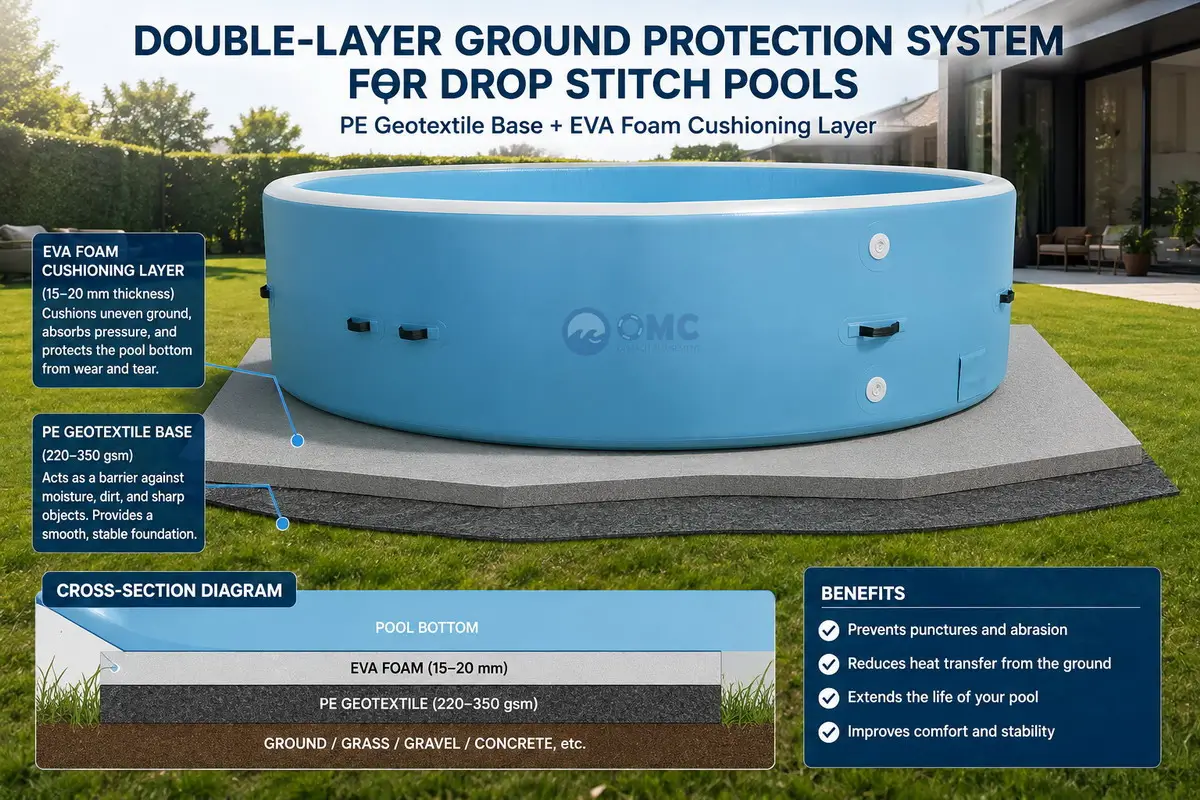
Layer 1 – PE fabric or geotextile (bottom)
This layer blocks moisture, isolates dirt and small stones, and keeps the EVA mat clean. A non‑woven geotextile of 220 gsm is the minimum. For wet or muddy sites, go 350 gsm or use a needle‑punched fabric with better drainage.
Layer 2 – EVA interlocking foam (top)
The EVA layer is your main defense against punctures and abrasion. Closed‑cell structure repels water. Interlocking edges cover any footprint without gaps. It also adds thermal insulation (great for cold plunge) and a slip‑resistant, comfortable surface.
Layer 3 – Drop Stitch Pool
Final stack: Ground → PE/Geotextile → EVA Foam → Drop Stitch Pool.
7. How much protection do you need? Sizing and calculation
How much bigger than the pool?
Industry rule: the mat should extend 30–50 cm beyond the pool’s footprint on all sides. This ensures full coverage, allows for slight movement during inflation, and stops the sidewalls from pressing onto bare ground. But don’t over‑size in commercial areas – too much overhang creates tripping hazards and collects dirt. For interlocking EVA, big overhangs can lift or shift.
How many EVA tiles do you need?
Two simple steps:
- Pool footprint area – circular: π × (diameter ÷ 2)². Rectangular: length × width.
- Add margin – for circular: π × (diameter/2 + 0.3 to 0.5m)². Divide by tile area, round up.
Example: 4m round pool with 0.4m margin → π × (2.4)² ≈ 18.1 m². If tiles are 0.5×0.5 m (0.25 m²), you need 73 tiles. Buy 5–10% extra for cutting and fitting.
8. Ground preparation – the step you can’t skip
This is the most important part. A mat protects the pool; the ground supports the water. If the ground isn’t ready, even the best mat won’t save you.
9‑step prep checklist
- Clear sharp objects – stones, twigs, glass, metal – anything that can cut.
- Check levelness – use a spirit level. Tolerance: ±5 mm per meter for pools up to 4m; tighter for larger.
- Check load capacity – ground must hold the full water weight. A 5m pool can exceed 15 tonnes. Industry standard: 2,500 kg/m² under the footprint.
- Check drainage – no standing water. A 1–2% slope away from the area is good for outdoor commercial sites.
- Lay PE fabric or geotextile – unroll the first layer with the 30–50 cm margin.
- Lay EVA or PVC protection – put the second layer on top, interlock or overlap. Avoid seams directly under heavy points.
- Smooth out wrinkles – both layers must be flat. Wrinkles create pressure points.
- Position the pool – center it. Inflate slowly and check it doesn’t shift.
- Final inspection after inflation – check bottom edge for lifting, uneven contact, or trapped debris.
Golden rule: Spend 80% of your time on ground prep, 20% on pool setup. This ratio works across thousands of installations.
9. Surface‑by‑surface guide
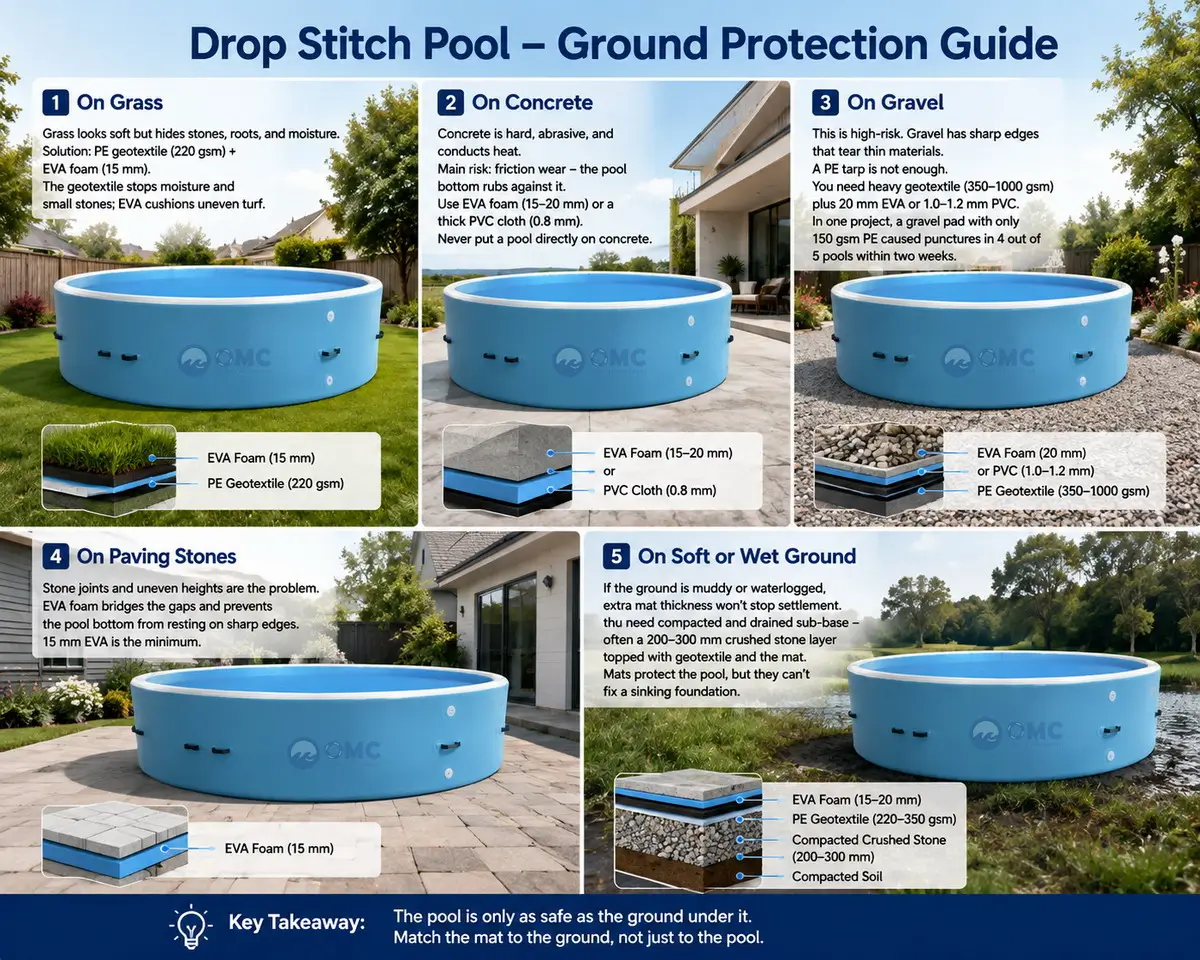
Drop Stitch Pool on grass
Grass looks soft but hides stones, roots, and moisture. Solution: PE geotextile (220 gsm) + EVA foam (15 mm). The geotextile stops moisture and small stones; EVA cushions uneven turf.
Drop Stitch Pool on concrete
Concrete is hard, abrasive, and conducts heat. Main risk: friction wear – the pool bottom rubs against it. Use EVA foam (15–20 mm) or a thick PVC cloth (0.8 mm). Never put a pool directly on concrete.
Drop Stitch Pool on gravel
This is high‑risk. Gravel has sharp edges that tear thin materials. A PE tarp is not enough. You need heavy geotextile (350–1000 gsm) plus 20 mm EVA or 1.0–1.2 mm PVC. In one project, a gravel pad with only 150 gsm PE caused punctures in 4 out of 5 pools within two weeks.
Drop Stitch Pool on paving stones
Stone joints and uneven heights are the problem. EVA foam bridges the gaps and prevents the pool bottom from resting on sharp edges. 15 mm EVA is the minimum.
Drop Stitch Pool on soft or wet ground
If the ground is muddy or waterlogged, extra mat thickness won’t stop settlement. You need compacted and drained sub‑base – often a 200–300 mm crushed stone layer topped with geotextile and the mat. Mats protect the pool, but they can’t fix a sinking foundation.
10. 5 common mistakes that cause pool failures
From 18 years of field reports, here are the top errors. They consistently lead to leaks, complaints, and lost profits.
Mistake #1 – Thin PE tarp on sharp gravel
We see this all the time. A 150 gsm tarp laid over gravel. It fails in days. Real example: A rental company in Arizona used 120 gsm tarps on desert gravel. After 10 rentals, 6 out of 8 pools had bottom leaks. They switched to 20 mm EVA + heavy geotextile – zero punctures over 50 rentals.
Mistake #2 – Thinking a thick mat fixes uneven ground
A 20 mm EVA mat smooths small bumps, but it won’t fix a 50 mm slope. The water weight deforms the mat and creates pressure points. Leveling is a site‑prep job, not a mat job.
Mistake #3 – Installing on concrete without friction protection
Concrete abrasion is a slow killer. The PVC bottom wears thinner until it leaks. A simple EVA mat stops this completely.
Mistake #4 – Using a mat smaller than the pool
Some buyers try to save money by going undersized. That leaves the pool edge exposed to ground contact and friction. Always size for the 30–50 cm margin.
Mistake #5 – Ignoring drainage on commercial outdoor sites
Standing water under the pool causes mold, degrades PVC, and softens the ground. Commercial contracts must include drainage – swales, French drains, or gravel beds – as part of ground prep.
11. Recommended specs by pool size
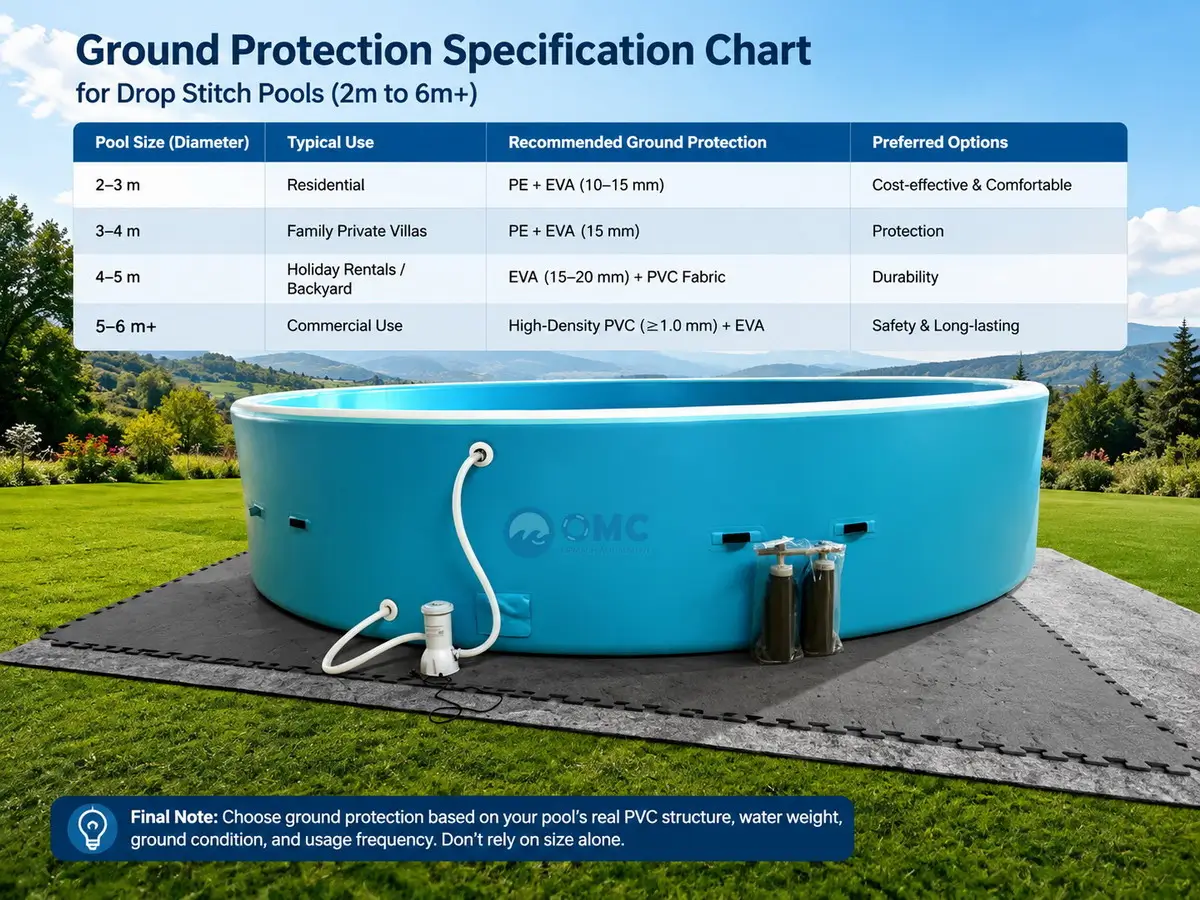
Use this table as a starting point. But remember: ground conditions and usage often matter more than size alone.
| Pool size | Typical use | Recommended protection | Priority |
|---|---|---|---|
| 2–3 m | Residential | PE + EVA (10–15 mm) | Cost & comfort |
| 3–4 m | Family / Villa | PE + EVA (15 mm) | Protection |
| 4–5 m | Resort / Large backyard | EVA (15–20 mm) + PVC cloth | Durability |
| 5–6 m+ | Commercial | Heavy‑duty PVC (1.0+ mm) + EVA | Safety & durability |
Final note: Always confirm specs based on the actual pool PVC structure, water weight, ground condition, and use frequency. Don’t rely on diameter alone.
12. FAQ – your most‑asked questions
The best Drop Stitch Pool Ground Mat for most outdoor setups is a two‑layer system: PE geotextile base + EVA foam. For commercial or gravel, use PVC coated fabric on top.
Yes, but you need protection. Grass hides stones and roots. Use PE + EVA to prevent punctures and improve comfort.
Yes, but concrete is abrasive. Use an EVA mat or PVC cloth to protect the bottom from friction wear.
For home use, 10–15 mm is enough. For 4m+ pools or commercial, go 20 mm or switch to heavy‑duty PVC.
It depends. EVA is softer – good for comfort. PVC is tougher – better for gravel, rentals, and rough surfaces.
A thin PE tarp won’t. You need a heavy geotextile (350+ gsm) plus thick EVA or PVC. And always prep the site well.
At least 30–50 cm on each side. This covers the full footprint and allows for small shifts.
Absolutely. Hotels and rentals face daily use. Use 0.8–1.2 mm PVC with proper drainage and compaction.
No. Mats protect, they don’t level. You must level the ground before laying any mat.
Heavy‑duty PVC coated fabric (0.8–1.2 mm, 1050–1500 gsm) plus a strong geotextile. These large pools need commercial‑grade protection.
13. Final buying recommendation
If your priority is…
- Lowest cost → PE woven fabric (220 gsm) – only for clean, indoor surfaces.
- Comfort → EVA foam (15–20 mm) – for grass, patios, hotels.
- Puncture protection → PVC coated fabric + EVA – for general safety.
- Gravel ground → Heavy‑duty multi‑layer (350+ gsm geotextile + 20 mm EVA or 1.2 mm PVC).
- Hotel / resort → Commercial PVC (0.8 mm) + EVA (15 mm) – for durability and looks.
- Rental business → Heavy‑duty, reusable PVC (1.0 mm) with reinforced edges.
- OEM brand → Custom‑size + logo + bundled packaging.
Core takeaway:
For most outdoor Drop Stitch Pools, a two‑layer system of PE/geotextile underneath and EVA foam above gives the best balance of puncture protection, cushioning, easy installation, and cost. For commercial or rough ground, upgrade to heavy‑duty PVC and tackle ground stability and drainage separately.
🌟 OMC Amusement makes high-pressure inflatables for global B2B brands. Buy direct from our factory to get wholesale pricing with zero middleman fees. We deliver most custom orders in 15 to 40 days with a proven 99.8% quality pass rate.
💼 Our Core Product Categories
- Drop-Stitch Lines: Heavy ice bath tubs, drop stitch swimming pools, inflatable yachts, docks, and floating platforms.
- Water Park Lines: Large lake parks, floating obstacle courses, and inflatable castles.
📬 Get a Factory-Direct Quote Within 24 Hours
Ready to update your inventory or build a custom pool? Contact our engineering desk right now for a fast reply.
- 📧 Email: info@omcplay.com
- 📲 WhatsApp / Tel: +86 15638116754
Leave your information and a professional consultant will reply.
- Previous article: Back To List
- Next article: Backyard Drop Stitch Pool Setup Guide