📑 Table of Contents
- 1. What Is Drop Stitch Fabric?
- 2. How Is Drop Stitch Fabric Manufactured?
- 3. The Working Principle of Drop Stitch Material
- 4. Key Advantages of Drop Stitch Fabric
- 5. Major Applications of Drop Stitch Material
- 6. Material Comparison: Drop Stitch vs. Standard PVC Inflatables
- 7. Technical Specifications of Drop Stitch Fabric
- 8. Which Pools Are Best Suited for Drop Stitch Technology?
- 9. B2B Procurement: How to Evaluate Drop Stitch Fabric Quality
- 10. The Supply Chain Architecture of Drop Stitch Fabric in China
- 11. Future Engineering Trends in Drop Stitch Materials
- 12. Conclusion: Engineering the Future of Inflatables
- 13. Frequently Asked Questions About Drop Stitch Fabric
1. What Is Drop Stitch Fabric?
🧠 Drop stitch fabric is a high-performance, three-dimensional composite material engineered to keep inflatable products completely flat, incredibly rigid, and structurally stable under extreme internal pressures. Unlike standard inflatables that bow or distort into rounded shapes when filled with air, this specialized material relies on thousands of high-tensile internal fibers to lock the top and bottom surfaces in a perfectly parallel alignment. Commercial procurement teams and product managers use drop stitch to build lightweight, portable equipment that matches the structural performance of solid wood or molded plastics. To review the foundational engineering definitions of this textile technology, the author has summarized the following information by consulting authoritative sources such as Wikipedia.
1.1 Definition and Core Concept of Drop Stitch Material
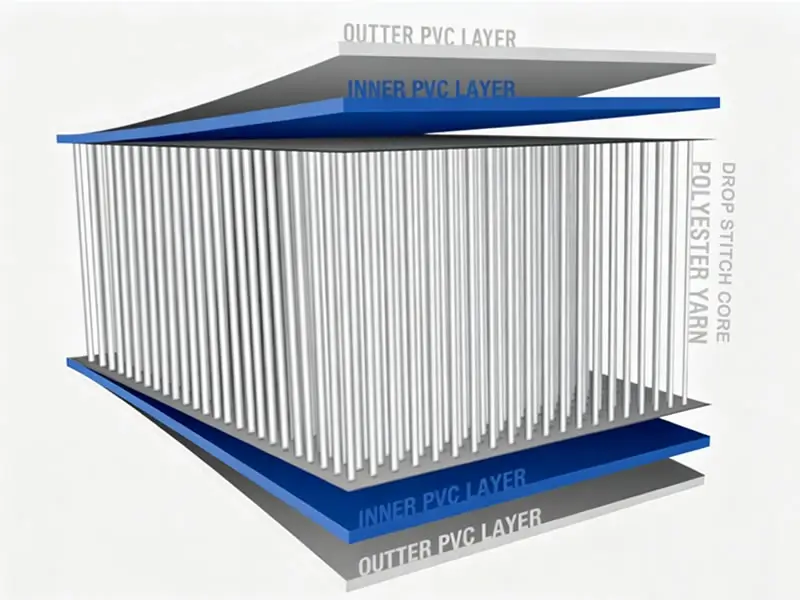
💡 Often listed in technical sourcing catalogs as Double Wall Fabric (DWF), drop stitch operates as a specialized pneumatic tension structure. It is built by taking two durable base fabrics and tying them together with a dense, uniform matrix of vertical polyester space threads. When you pump air into this sealed chamber, the internal threads pull taut instantly. They act as thousands of tiny structural columns, stopping the material from expanding outward and forcing the inflatable to hold a flat, rock-hard profile.
1.2 Why Is It Called "Drop Stitch"?
🧵 The name comes straight from the unique textile machinery used to create the material. Specialized double-needle looms alternate continuously between the upper and lower base cloths. As the needles move up and down, they literally "drop" stitches back and forth to interlock the two layers. This automated weaving process creates a single, inseparable 3D piece that handles high internal air pressures without any risk of delamination.
1.3 Drop Stitch vs. Standard PVC Inflatable Materials
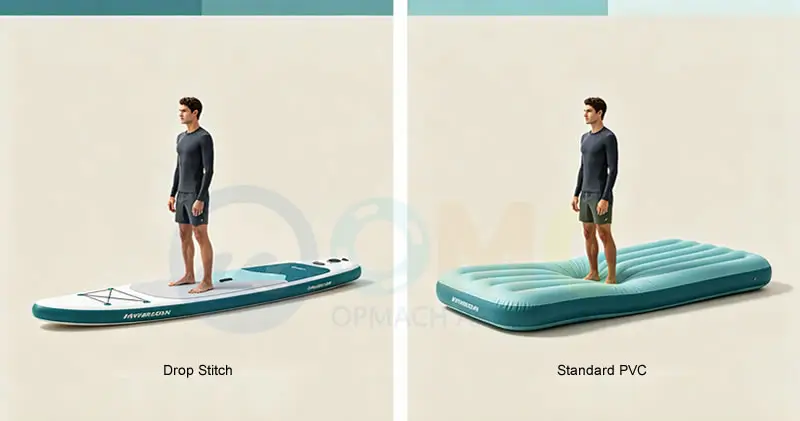
⚖️ Traditional inflatables made from basic, unsupported PVC rely on an open, hollow core. Because air distributes pressure evenly in every direction, a regular PVC tube will always round out and swell as you inflate it. Drop stitch solves this physical limitation entirely. By using internal thread constraints, it allows you to deploy a premium drop stitch pool or structural water deck that stays flat, stable, and completely level even when multiple adults walk across the surface.
1.4 The Internal Anatomy: Three-Dimensional Core Structure
🔬 Look inside a premium piece of drop stitch material, and you will see an advanced composite sandwich setup built for heavy-duty commercial use. The core features a dense network of high-tensile polyester space yarns, packing up to 15,000 stitches per square meter. This core is anchored directly into the top and bottom base weaves, which are sealed with multiple airtight, gas-retaining coatings to distribute localized weights evenly across the entire surface.
2. How Is Drop Stitch Fabric Manufactured?
🏭 Manufacturing drop stitch fabric requires a precise, multi-stage production line that merges high-speed textile weaving with heavy-duty polymer coating. Production plants must stick to strict global quality standards, such as ISO guidelines for coated industrial textiles, to make sure there are no micro-leaks or uneven thread tensions. Even a tiny error during the weaving stage can ruin the load capacity of the final inflatable when it is pressurized in the field.
2.1 Phase 1: Base Fabric Weaving (Polyester Warp and Weft)
🏗️ The process starts on advanced double-bed weaving looms, where high-strength polyester yarns are interlocked into two parallel sheets. Workers align the warp and weft fibers precisely to deliver excellent multi-directional tear resistance. Most commercial-grade products use raw yarns with a linear density of 1000 Denier (1000D), creating a tough structural foundation that survives years of repeated inflating, deflating, and folding.
2.2 Phase 2: High-Density Vertical Thread Interlocking
🪡 As the loom builds the top and bottom layers, it simultaneously drops thousands of vertical space threads between them. The machine settings lock in the exact distance between the layers, establishing the precise thickness of the finished, deflated fabric sheet. Computerized tension sensors track every single thread to ensure the entire internal matrix pulls with equal force when the product is inflated.
2.3 Phase 3: Liquid PVC Coating and Thermal Hot-Press Lamination
🔥 Once the raw 3D textile core leaves the loom, it moves to the coating line. Here, technicians apply a liquid PVC formula to seal the raw weave and make it completely airtight. Next, large calendering rollers use heat and high pressure to fuse a structural layer of marine-grade PVC film onto the outside. For specialized projects that require extra resilience, factories can apply a premium Polyurethane (TPU) film to protect against grease, harsh chemicals, and extreme weather.
2.4 Phase 4: Finished Product Quality and Compliance Inspection
🛡️ Every finished roll undergoes a mandatory quality check before shipping. Technicians run a continuous 24-hour high-pressure air leak test, check the material's grab-tensile strength, and run pressurized seam-burst evaluations. Any material heading to commercial water parks or luxury resorts must pass clear tests showing the threads will not pull out or delaminate under high summer temperatures.
3. The Working Principle of Drop Stitch Material
🌬️ The engineering behind drop stitch is simple: it uses internal physical tension to balance outward air pressure. When you pump air into a standard inflatable, it swells along the path of least resistance. In a drop stitch structure, that outward expansion pulls the internal polyester threads completely taut. This tension stops the fabric from swelling and turns air pressure into a rigid, solid panel.
3.1 Why Drop Stitch Maintains a Flat Surface Under Inflation
📐 The flat surface stays perfectly level because the internal threads act as high-precision anchors. Because every single thread is cut to the exact same length and spaced evenly across every square inch of the material, they force the outer PVC skins to remain flat. As the air pushes out, these thousands of tiny anchors pull back, giving you a smooth, flat deck that handles concentrated weight without bowing.
3.2 High-Pressure Support Mechanics: Standard PVC vs. Drop Stitch
📊 The big difference between these two designs comes down to safe working pressures. Regular PVC inflatables can only handle low pressures, usually operating between 0.2 PSI and 0.5 PSI—anything higher will distort the plastic or pop the seams. Drop stitch composites easily handle continuous everyday working pressures from 8 PSI up to 20 PSI. This high internal pressure creates an incredibly solid platform that can support groups of people or heavy gear without bending.
4. Key Advantages of Drop Stitch Fabric
🌟 Drop stitch fabric has changed the game for commercial outdoor equipment, replacing heavy wood, fiberglass, and molded plastics in many industries. For purchasing teams, this material offers the perfect mix of rugged field durability and simple shipping, making it the top choice for rental businesses, athletic clubs, and commercial waterfront facilities.
- 🛹 Rigid Performance That Mimics Solid Wood: Inflate the material to 15+ PSI, and it barely flexes. Athletes and commercial users can walk, run, and jump across the surface without feeling any sponginess or sagging.
- 🏋️ High Load-Bearing Capacity Across the Surface: A standard 15cm thick commercial drop stitch deck can support over 300 kg per square meter because it spreads concentrated weight evenly across thousands of internal fibers.
- 📦 Folds Down Small to Cut Shipping Costs: Open the valves, let the air out, and even a large 4-meter platform rolls up into a compact bundle. This drastically lowers your international freight fees and storage warehouse space.
- 🌊 Built to Handle Real-World Outdoor Abuse: The outer shell features heavy, marine-grade 0.0.7mm to 1.2mm PVC. It shrugs off scrapes against gravel, resists intense sun degradation, and stands up to long-term saltwater use.
- 🔧 Simple Field Repairs Keep Gear Working: If something sharp punctures the skin, you do not need to scrap the product. You can patch it quickly with industrial PVC adhesive and patches, getting it back up to full pressure in a few hours.
5. Major Applications of Drop Stitch Material
🏄 The strength and portable nature of double-wall drop stitch composites have made them highly popular across the global water sports and leisure markets. Because the material feels completely solid when pumped up, engineering teams use it to build mobile gear that used to require heavy metal or plastic frames.
5.1 Drop Stitch Inflatable Pools and Cold Plunges
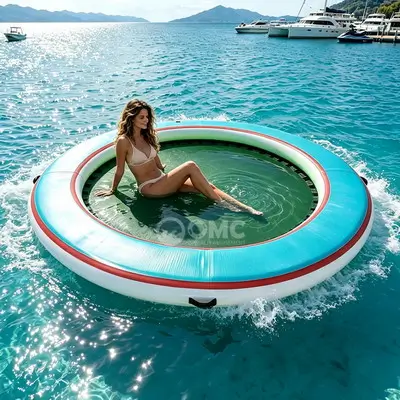
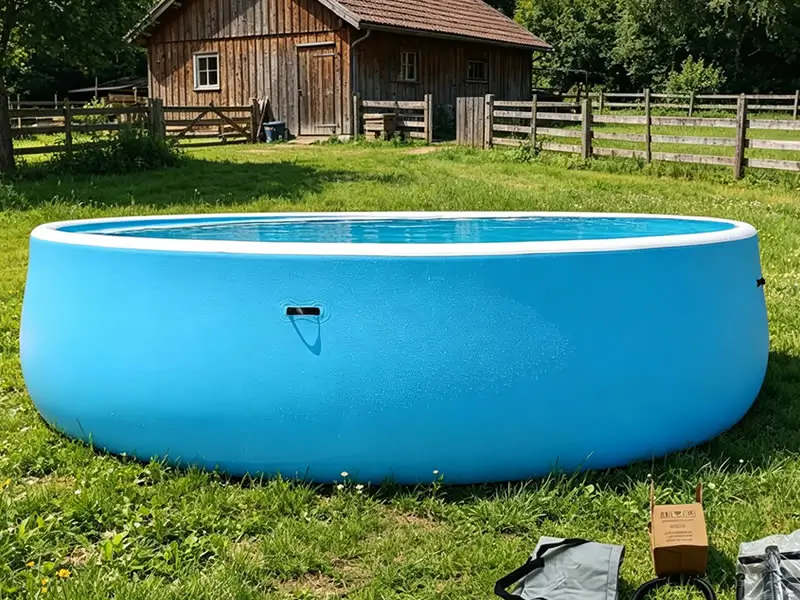
🏊 Modern high-pressure pools use drop stitch panels for their side walls to maximize swimming space and structural strength. These walls are thin but completely rigid, so swimmers can sit or lean right on the edge without the pool collapsing or losing water. This setup is a favorite for athletic training camps and compact Cold Plunge Pools (Ice Baths) that need great insulation, clear dimensions, and easy transport between events.
5.2 High-Performance Inflatable Stand-Up Paddle (SUP) Boards
🏄 Drop stitch completely changed the stand-up paddleboard industry. Inflatable SUPs use 10cm to 15cm thick cores to give paddlers a rock-solid deck that glides smoothly over water, offering the performance of a hard fiberglass board but packing away easily into a standard backpack.
5.3 Heavy-Duty Floating Docks and Commercial Water Platforms
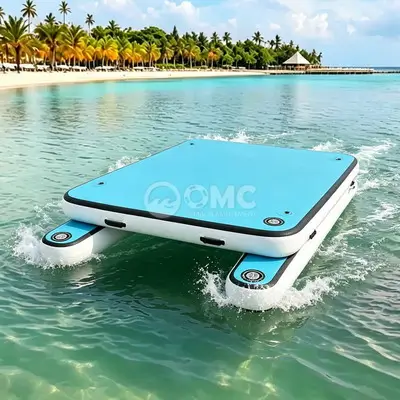
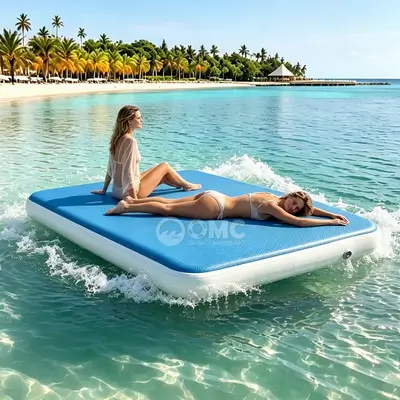
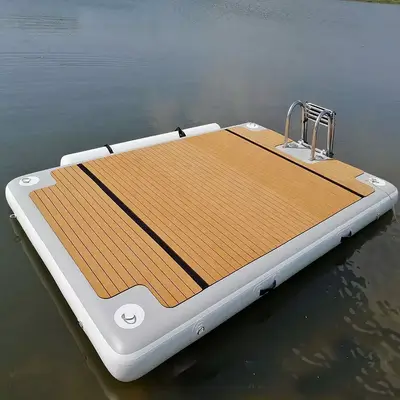
⚓ Resorts, commercial marinas, and yacht owners use modular drop stitch docks to add extra usable deck space to the water. You can link these rigid platforms together to park jet skis, build temporary walkways for boat passengers, or set up floating swim lounges in open water.
5.4 Air Gymnastics Mats and Impact-Absorbing Tracks
🤸 Gymnastics centers and cheerleading gyms use high-pressure drop stitch air tracks to keep athletes safe. These air mats offer excellent shock absorption and bounce. Coaches can easily adjust the firmness by adding or releasing air, protecting athletes' joints during heavy tumbling practices.
5.5 Inflatable Kayaks and Rigid Boat Floors
🚣 Premium inflatable boats and kayaks use drop stitch panels for their floors and hulls. A high-pressure floor gives the kayak a sleek shape in the water, reducing drag and stopping the hull from bending upward when navigating rough whitewater rapids.
6. Material Comparison: Drop Stitch vs. Standard PVC Inflatables
| Technical Evaluation Parameter | Premium Drop Stitch Fabric (DWF) | Standard Unsupported PVC Film |
|---|---|---|
| Safe Operational Pressure | 8.0 – 20.0 PSI | 0.2 – 1.0 PSI |
| Surface Structural Rigidity | Extreme (Solid Plank Profile) | Pliable / Elastic (Bulging Shape) |
| Maximum Load-Bearing Capacity | High (Up to 350+ kg/m²) | Low to Moderate (Prone to sagging) |
| Long-Term Durability Matrix | Excellent (Industrial Outdoor Grade) | Moderate (Prone to seams splitting) |
| Initial Sourcing Cost Index | Higher Investment Profile | Economical / Low-Cost Entry |
| Primary Product Application | Commercial SUPs, Docks, Elite Pools | Leisure Inflatables, Beach Balls, Toys |
7. Technical Specifications of Drop Stitch Fabric
📐 Choosing the right material specifications ensures your final product handles the physical demands of your target market. Drop stitch fabric is highly customizable, letting your product development team choose the exact thickness, thread density, and outer PVC weight required for your specific project.
7.1 Standard Profile Thicknesses (10cm to 30cm)
📏 The thickness of the drop stitch panel directly controls how much weight it can carry without bending. Standard options include 10cm (4 inches) for lightweight gym mats and slim surfboards, 15cm (6 inches) for backyard swimming pools and standard floating docks, and 20cm to 30cm (8 to 12 inches) for commercial work platforms and heavy-duty walkways that need high buoyancy.
7.2 Thread Stitch Densities per Square Meter
🕸️ Thread density changes how smooth the surface feels and how much internal shear stress the panel can handle. Standard entry-level options use roughly 10,000 stitches/m², while heavy-duty commercial materials use 13,000 to 15,000 stitches/m². High stitch counts minimize surface dimples, leaving you with a sleek, flat finish under full pressure.
7.3 PVC Base Material Thickness and Weight
🛡️ You should choose your outer protective skin based on where the product will be used. Options start at 0.7mm PVC for light consumer gear, moving up to 0.9mm reinforced PVC for everyday commercial rentals, and hitting 1.2mm PVC for heavy-duty military or industrial docks that constantly rub against concrete walls or rough sand.
8. Which Pools Are Best Suited for Drop Stitch Technology?
🏡 Drop stitch panels excel in situations where traditional metal or plastic frames are too heavy to transport or too easily damaged by constant commercial use. Engineering teams can build these shapes to fit tight spaces or deep setups without compromising safety. Sourcing professionals looking to analyze factory options can check out the Inflatable Pool Manufacturers Complete Industry Guide.
- 🏡 High-End Backyard Family Pools: Perfect for premium residential properties that want a fast setup (under 10 minutes) with solid side walls that let people sit directly on the rim without spilling water.
- 🏢 Commercial Mobile Pools & Public Events: Built for temporary brand events, swim schools, and mobile water attractions where the gear needs to be set up, taken down, and moved quickly.
- ❄️ Athletic Cold Plunges & Ice Baths: Deep, compact tubs built to handle heavy water volume and connect directly to commercial chillers. The tight material construction acts as a natural insulator to keep water temperatures steady.
- 🐕 Hydrotherapy Pools and Pet Tubs: Upgraded with thick 1.2mm reinforced outer PVC skins to handle sharp dog claws without puncturing, providing an easy, stable step-over solution for pet care facilities.
9. B2B Procurement: How to Evaluate Drop Stitch Fabric Quality
🔎 Protecting your brand from expensive product returns means knowing how to spot high-quality drop stitch before signing bulk contracts. Sourcing teams must prioritize verified safety and chemical testing data over cheap pricing. Look for components that pass strict regional market standards, like ASTM International rules or CPSC safety guidelines, to ensure your inventory is non-toxic and structurally sound.
9.1 Analyzing Thread Density and Drop-Stitch Consistency
🔍 Premium materials feature perfectly even internal thread rows with zero missing lines or gaps. A quick trick for procurement managers is to hold physical samples up against a strong light source. This instantly reveals any skipped stitches or weave defects that could cause the surface to bubble or warp later.
9.2 Verifying PVC Layer Thickness and Tensile Strengths
💎 Make sure the external coatings are applied using multi-pass knife-over-roller methods or heavy-duty lamination lines. Shoddy factories often pad their thickness measurements by using thick layers of cheap glue mixed with fillers, which ruins the fabric's actual tear strength and leaves it prone to punctures.
9.3 Air Tightness and High-Pressure Seam Integrity
💨 Seams are the most critical failure point on any high-pressure inflatable. Premium products use high-frequency overlapping welds or structural Double-Reinforced Rail Bands that lock the edges inside extra layers of tough tape, skipping cheap adhesives that fail when left out in the hot sun.
9.4 Lamination Overlap and High-Frequency Welding Precision
⚡ Look closely at the weld lines on production samples. Check for any burn marks, air bubbles, or wandering seams. A clean, uniform high-frequency weld shows the factory calibrates its machinery correctly, meaning the seams will hold tight when the air expands in extreme heat.
9.5 Raw Material Traceability and Chemical Testing Compliance
🧪 Any product entering competitive retail markets needs clear batch tracking for its raw materials. Make sure your supplier provides independent lab paperwork proving the PVC blend is REACH compliant (phthalate-free) and loaded with high-grade UV blockers to stop the material from turning yellow and cracking.
10. The Supply Chain Architecture of Drop Stitch Fabric in China
China runs the global supply chain for drop stitch composites, hosting highly efficient industrial manufacturing hubs. This concentrated network gives international buyers a massive advantage by offering fast prototyping, rapid manufacturing scaling, and reliable raw material supply lines.
10.1 Core Manufacturing Clusters: Jiangsu, Zhejiang, Henan, and Shandong Provinces
📍 Production is concentrated across four key coastal areas. Jiangsu and Zhejiang provinces handle advanced textile spinning and chemical coating lines, focusing on raw material innovation. At the same time, Shandong and Henan province specializes in turning that finished fabric into completed commercial products like paddleboards, platforms, and pools.
10.2 Vertical Integration and Global Export Capabilities
🚢 Chinese manufacturing plants benefit from excellent vertical integration. Thread spinning, 3D weaving, PVC coating, and final product assembly frequently happen within the same industrial park. This streamlined process eliminates local transit delays, cuts production costs, and guarantees consistent quality control across your entire production run.
11. Future Engineering Trends in Drop Stitch Materials
🚀 The future of drop stitch materials focuses on dropping overall product weight while pushing tear strengths and environmental performance higher. Thanks to recent breakthroughs in polymer chemistry, factories are moving toward cleaner, smarter setups built to survive decades of heavy outdoor use.
11.1 TPU Drop Stitch: Transitioning to Eco-Friendly Thermoplastic Polyurethane
🌱 Moving from old PVC blends to Thermoplastic Polyurethane (TPU) is a massive step forward for the industry. TPU drop stitch fabric is fully recyclable, stays perfectly flexible even in freezing weather, offers better scrape resistance, and drops total product weight by roughly 30% compared to old-school PVC.
11.2 Double-Wall Fabric (DWF) and Ultra-High Tensile Woven Matrixes
🕸️ New cross-woven patterns are quickly taking over from traditional vertical stitching styles. By crossing the internal yarns at precise diagonal angles instead of straight vertical lines, the fabric gains incredible torsional stiffness. This means the final pool or dock stays perfectly rigid at lower inflation pressures.
11.3 Advanced UV-Resistant and Marine-Grade Chemical Additives
☀️ Modern commercial setups demand better defense against the elements. The latest premium fabrics have anti-microbial treatments and advanced UV blockers mixed directly into the outer raw polymer, stopping material rot and keeping the fabric strong under constant sun and saltwater exposure.
11.4 Smart Inflatables: Integrated Electronic Pressure Monitoring Systems
📲 Wireless technology is officially hitting the inflatable market. Modern drop stitch chambers can be built with embedded micro-sensors that track internal air pressure shifts, temperature changes, and tiny leaks in real time, sending alerts straight via Bluetooth to your fleet management app.
12. Conclusion: Engineering the Future of Inflatables
🎯 Drop stitch fabric has completely rewritten the rulebook for high-pressure inflatable gear. By delivering rigid strength without the bulk, it allows commercial brands to ship durable aquatic equipment around the world at minimal cost. Partnering with a reliable factory and sticking to strict component standards is your absolute key to winning long-term market share.
🤝 Partner with OMC Amusement for Premium Custom Solutions: As an established industry leader, OMC Amusement delivers full OEM/ODM personalized customization built around your brand's unique specifications. We provide factory-direct sourcing, rigorous multi-stage quality checks, and custom structural design for high-pressure drop stitch pools, commercial floating docks, and custom inflatable tents. Message our engineering design team today to grab detailed material samples, technical specifications, and factory-direct volume pricing for your upcoming product launch!
13. Frequently Asked Questions About Drop Stitch Fabric
Q: What is drop stitch fabric?
A: Drop stitch fabric is a specialized three-dimensional composite made by joining two parallel base fabrics with thousands of internal high-tensile polyester threads. This allows it to hold high air pressures, creating a flat, rigid platform that performs like a solid wood or plastic deck.
Q: How many PSI can drop stitch material safely handle?
A: Commercial-grade drop stitch material safely runs between 8 PSI and 20 PSI, depending on the product thickness and how the seams are built. Regular low-pressure PVC inflatables can usually only handle up to 1.0 PSI before warping or bursting.
Q: Are drop stitch pools superior to standard PVC inflatable pools?
A: Yes, they are far more durable and stable. Drop stitch side walls are thin and pump up rock-hard, meaning swimmers can lean or sit directly on the pool edge without causing it to bend, sag, or dump water into the yard.
Q: What is the expected service lifespan of drop stitch material?
A: A high-quality drop stitch product built with marine-grade PVC or TPU and proper UV-blocking treatments will easily last between 5 to 10 years under normal commercial use, as long as it is dried and stored properly when out of service.
Q: Is drop stitch fabric easy to repair if punctured?
A: Yes, it is very simple to service in the field. You can fix small punctures permanently using industrial-grade polyurethane adhesives and matching PVC repair patches, restoring full airtight pressure performance within a couple of hours.
🌟 OMC Amusement makes high-pressure inflatables for global B2B brands. Buy direct from our factory to get wholesale pricing with zero middleman fees. We deliver most custom orders in 15 to 40 days with a proven 99.8% quality pass rate.
💼 Our Core Product Categories
- Drop-Stitch Lines: Heavy ice bath tubs, drop stitch swimming pools, inflatable yachts, docks, and floating platforms.
- Water Park Lines: Large lake parks, floating obstacle courses, and inflatable castles.
📬 Get a Factory-Direct Quote Within 24 Hours
Ready to update your inventory or build a custom pool? Contact our engineering desk right now for a fast reply.
- 📧 Email: info@omcplay.com
- 📲 WhatsApp / Tel: +86 15638116754