📑 Table of Contents
- 1. Market Overview & Size (2025-2028) 🌍
- 2. Regional Market Analysis 📊
- 3. China Manufacturers’ Global Share & Position 🏭
- 4. Core Technology & Safety Standards ⚙️
- 5. Market Drivers & Demand Trends 📈
- 6. Risks & Industry Challenges ⚠️
- 7. 2026-2028 Key Industry Trends ✨
- 8. SWOT Analysis for China Manufacturers 🧐
- 9. OMC Amusement Factory Perspective 💡
- 10. FAQ ❓
1. Market Overview & Size (2025-2028) 🌍
The global inflatable pool market is in a strong expansion phase, driven by backyard leisure demand, climate change, and e-commerce growth. In 2025, the market reached approximately USD 2.8-3.0 billion, with forecasts indicating growth to USD 3.0-3.3 billion in 2026 and USD 3.7-4.2 billion by 2028. The compound annual growth rate (CAGR) for 2025-2028 is projected at 7.4%-8.6%, outpacing many traditional consumer goods sectors.
Inflatable Pool Swimming manufacturer production capacity has scaled rapidly to meet this demand, with China-based facilities accounting for over 75% of global output. The market’s value lies in its accessibility: inflatable pools cost 90% less than permanent installations, making them ideal for suburban and urban households seeking affordable summer recreation.
2. Regional Market Analysis 📊
Regional demand varies by consumer behavior, climate, and economic development, with four key regions dominating consumption:
- North America (38% share, ~USD 12.2B in 2026): The largest market, driven by high backyard penetration (72% of U.S. households) and heatwave frequency. Demand focuses on premium, large-capacity pools.
- Europe (29% share, ~USD 9.3B): Strong demand in Germany, UK, and France, with strict eco-safety regulations shaping product specs. Consumers prioritize non-toxic materials and sustainable production.
- Asia-Pacific (25% share, ~USD 8.0B): China dominates (80%+ of APAC demand), fueled by middle-class growth and urbanization. Southeast Asia and India emerge as fast-growing submarkets.
- Middle East & Others (8% share, ~USD 2.5B): Year-round hot climates drive consistent demand, with luxury resorts and residential complexes adopting inflatable pools for cost efficiency.
The Asia-Pacific region is the fastest-growing (CAGR 9.2%), supported by China’s manufacturing ecosystem and rising disposable incomes in developing economies.
3. China Manufacturers’ Global Share & Position 🏭
China is the undisputed manufacturing hub for inflatable pools, controlling a dominant share of global supply chains and production capacity.
3.1 Production & Export Metrics
- Global Capacity Share: 75%-80% of worldwide inflatable pool production, concentrated in Zhejiang, Shandong, Henan, and Guangdong provinces.
- Export Value (2025): ~USD 2.1 billion, representing 70%+ of global inflatable pool trade volume.
- 2026-2028 Forecast: China’s global market share (including foreign-owned factories in China) will remain stable at 68%-72%, with domestic manufacturers capturing 58%-62% of the total market.
3.2 Competitive Landscape (2026)
| Tier | Key Players | Global Share | Core Positioning |
|---|---|---|---|
| 1st (Global Giants) | Bestway (China), Intex (US-owned, China-based) | 22% + 18% = 40% | Premium + mass-market dual layout, global distribution |
| 2nd (Local Leaders) | Jilong, Jasonwell, Weibang, OMC Amusement, Yingtai | 5%-7% + 8%-10% = 13%-17% | Cost-effective, OEM/ODM focus, regional specialization |
| 3rd (Small-Medium Factories) | Thousands of Chinese OEMs | 15%-20% | Low-cost, small-batch customization, price competition |
Inflatable Pool manufacturer in China benefits from unmatched supply chain integration: raw material suppliers, mold makers, printing workshops, and assembly lines cluster within 200km of major production bases, cutting costs by 30%-40% vs. Western manufacturers.
4. Core Technology & Safety Standards ⚙️
Product quality and safety compliance are critical for global market access, with strict standards enforced by regulators like the U.S. CPSC.
4.1 Key Materials & Tech Specifications
- PVC (Polyvinyl Chloride): Dominant material (85% of products), low cost, waterproof, and durable. Standard thickness: 0.25mm-0.6mm; UV-resistant coatings required for outdoor use.
- TPU (Thermoplastic Polyurethane): High-end alternative (10%-15% of market), eco-friendly, abrasion-resistant, and recyclable. Premium pools use multi-layer TPU/PVC composites for puncture resistance.
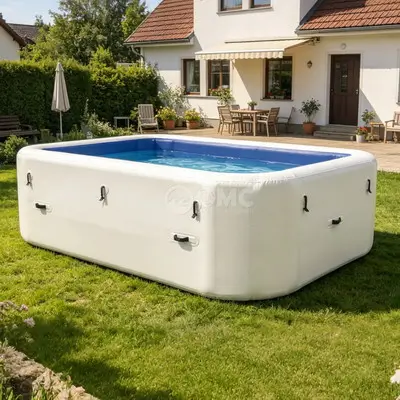
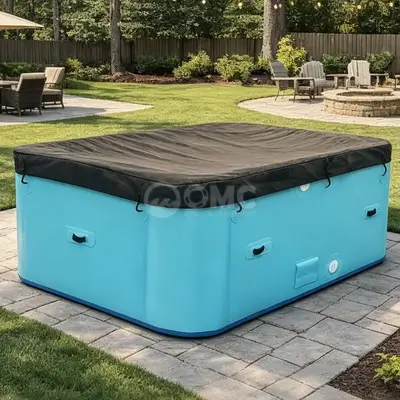
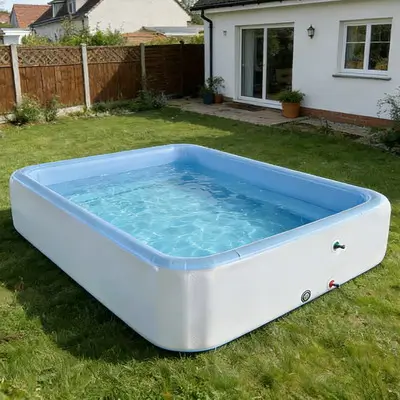
- Drop Stitch Technology: Used in high-pressure inflatable pools, enabling rigid, flat surfaces. Common in luxury models (e.g., Bestway’s Hydro-Force line).
4.2 Global Safety & Compliance Standards
- CPSC (U.S.): Mandates compliance with ASTM F963 (physical safety), CPSIA (lead ≤100ppm, phthalates ≤0.1%). Warning labels (e.g., “Never leave child unattended”) are required for all children’s poolsCPSC.
- EU Standards: REACH (restricts 1,600+ harmful substances), CE marking, and EN 71 (toy safety) apply to inflatable pools sold in Europe.
- ISO 8124: International standard for inflatable leisure products, covering material safety, structural integrity, and labeling.
Compliance costs have risen by 15%-20% since 2023 due to stricter环保 regulations, favoring large manufacturers with dedicated QC teams.
5. Market Drivers & Demand Trends 📈
Three primary factors fuel market growth, with China manufacturers positioned to capitalize on each trend:
- Backyard Leisure & Staycation Boom: Post-pandemic, 68% of Western households prioritize affordable home recreation over expensive vacations. Inflatable pools (USD 50-200) are a low-risk, high-reward purchase for familiesCPSC.
- Climate Change & Heatwave Frequency: Global average temperatures have risen by 1.1°C since the pre-industrial era, increasing summer heatwave duration and intensity. In 2025, 72% of inflatable pool sales in North America were driven by heatwave events.
- E-Commerce Penetration & DTC Growth: Online channels account for 65% of global inflatable pool sales (2025), with Amazon, TikTok Shop, and Alibaba International as top platforms. Chinese manufacturers excel at DTC operations, bypassing traditional retailers to boost profit margins by 20%-30%.
Additional drivers include urbanization (small living spaces favor portable products) and rising middle-class incomes in emerging markets (Southeast Asia, Latin America).
6. Risks & Industry Challenges ⚠️
Despite strong growth, the industry faces headwinds that impact profitability and supply chain stability:
- Raw Material Price Volatility: PVC prices (tied to oil) fluctuate by 10%-15% annually, accounting for 50%-60% of production costs. TPU prices are more stable but 2-3x higher than PVC.
- Strict Environmental Regulations: EU REACH and U.S. CPSC bans on harmful chemicals (e.g., certain phthalates) require costly material upgrades and third-party testing. Non-compliance leads to product recalls and market bansCPSC.
- Trade Barriers & Anti-Dumping Risks: North America and Europe have imposed tariffs (10%-25%) on Chinese inflatable products, with potential anti-dumping investigations looming. This increases landed costs and reduces price competitiveness.
- Low-End Market Saturation & Price Wars: Thousands of small Chinese factories compete on price, driving down average selling prices by 3%-5% annually and compressing profit margins to 5%-10%.
7. 2026-2028 Key Industry Trends ✨
The inflatable pool market is evolving rapidly, with three transformative trends shaping product development and competition:
7.1 Premiumization & Smart Features
Consumers are upgrading from basic inflatable pools to high-value models with integrated features: LED lighting, built-in filtration systems, smart temperature monitors, and app connectivity. Premium products command a 30%-50% price premium, with Bestway and Jilong leading innovation.
7.2 Sustainable & Eco-Friendly Materials
65% of global consumers prefer products made from sustainable materials. Manufacturers are shifting to recycled PVC, bio-based TPU, and BPA-free coatings to meet demand. By 2028, sustainable materials will account for 25% of total inflatable pool production.
7.3 Customization & Niche Market Expansion
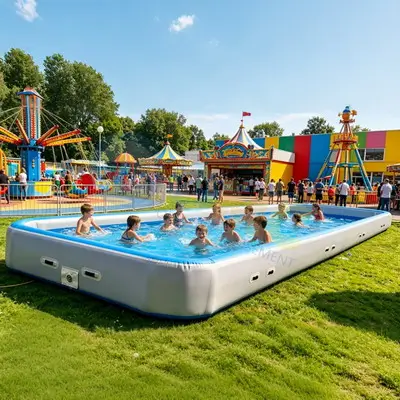
OEM/ODM services are in high demand, with brands seeking unique shapes, sizes, and branding options. Niche segments (e.g., luxury inflatable spas, commercial-grade event pools, and kid’s themed pools) are growing faster than the mass market (CAGR 10%-12%).
8. SWOT Analysis for China Manufacturers 🧐
| Strengths (S) | Weaknesses (W) |
|---|---|
|
|
| Opportunities (O) | Threats (T) |
|
|
9. OMC Amusement Factory Perspective 💡
As a leading OEM/ODM inflatable pool manufacturer, OMC Amusement leverages China’s industrial advantages to deliver high-quality, cost-effective inflatable pools for global brands and retailers. Our core strengths include:
- Customization Expertise: One-stop OEM/ODM service, from design, mold development, material selection to production. Support personalized sizes, colors, logos, and functional features (e.g., LED lights, filtration systems).
- Strict Quality & Compliance: All products comply with CPSC, EU REACH, and ISO standards. Use food-grade, BPA-free PVC/TPU materials, with 3rd-party testing reports for every batch.
- Fast Delivery & Support: 7-day sampling, 30-45 day mass production, global shipping support, and 1-year warranty for manufacturing defects.
omc amusement focuses on bridging China’s manufacturing prowess with global market demand, helping brands launch competitive inflatable pool products while maximizing profitability.
10. FAQ ❓
Q1: What is the global inflatable pool market size in 2026?
A1: The global inflatable pool market is projected to reach USD 3.0-3.3 billion in 2026, growing at a CAGR of 7.4%-8.6% from 2025 to 2028.
Q2: What share of global inflatable pools are made in China?
A2: China manufactures 75%-80% of global inflatable pool capacity, with Chinese companies holding a 58%-62% global market share (2026).
Q3: What safety standards apply to inflatable pools sold in the US?
A3: US-sold inflatable pools must comply with CPSC/ASTM F963 (physical safety), CPSIA (lead ≤100ppm, phthalates ≤0.1%), and mandatory warning labels.
Q4: What are the key trends in inflatable pools for 2026-2028?
A4: Key trends include premium smart features (LED, filtration), sustainable materials (recycled PVC, bio-TPU), and customized OEM/ODM products for niche markets.
🌟 OMC Amusement makes high-pressure inflatables for global B2B brands. Buy direct from our factory to get wholesale pricing with zero middleman fees. We deliver most custom orders in 15 to 40 days with a proven 99.8% quality pass rate.
💼 Our Core Product Categories
- Drop-Stitch Lines: Heavy ice bath tubs, drop stitch swimming pools, inflatable yachts, docks, and floating platforms.
- Water Park Lines: Large lake parks, floating obstacle courses, and inflatable castles.
📬 Get a Factory-Direct Quote Within 24 Hours
Ready to update your inventory or build a custom pool? Contact our engineering desk right now for a fast reply.
- 📧 Email: info@omcplay.com
- 📲 WhatsApp / Tel: +86 15638116754